The Mind is Logical Philosophy
The mind is a logical philosophy.
Philosophy is a mind that captures images, and logic that shapes them into wisdom.
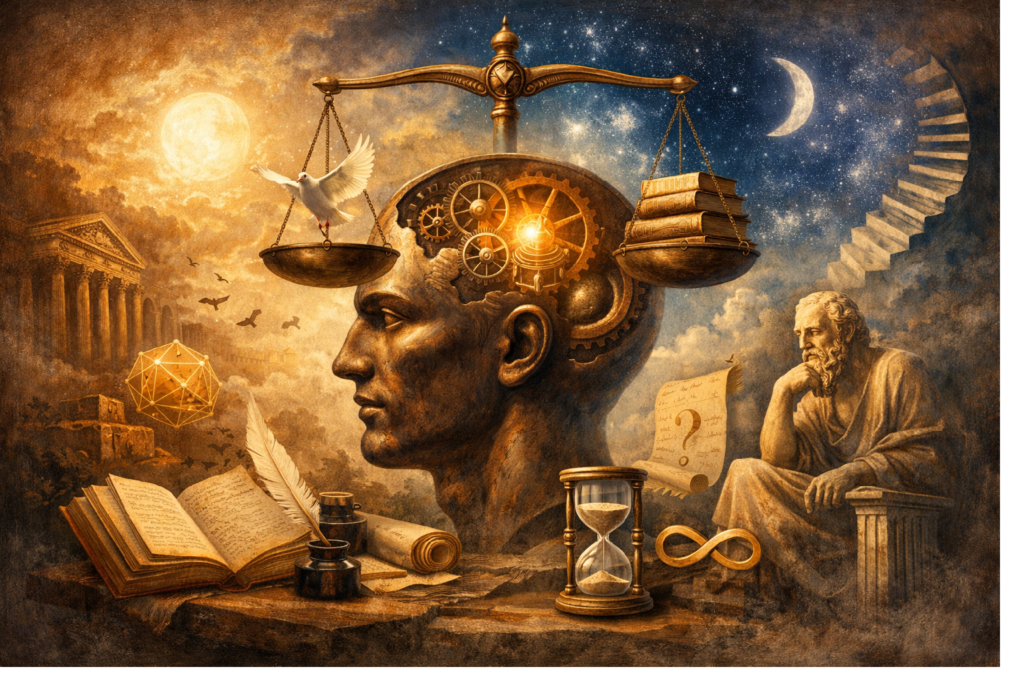
Philosophy is not words written on paper, nor speeches delivered in gatherings, but rather a profound mental movement that captures things as images, transforms events into internal scenes, and then re-presents them with a rigorous logic that weighs them and establishes laws for them. It is a mental effort that exhausts the mind more than the body, because it does not merely observe reality, but analyzes it and re-formulates it as it should be, even if it appears unnatural on the surface
The philosopher experiences events as if they were an internal film, observing the characters, following the plot, and transforming each scene into a mental summary. Logic here is not simply rigid rules, but an internal scale that weighs freedom and justice, corrects the arrogant, vindicates the oppressed, and transforms difficulties into lessons for the soul.
In this sense, philosophy is not an intellectual luxury, but a hidden force around which various events revolve, centered on the mind, and its essence is logic. It is the ability to see beyond what is immediately before you, to connect experiences and expectations, and to forge from imagination a realistic conclusion imbued with wisdom.
Philosophy as an Internal Portrait
Philosophy as an Internal Portrait: A philosopher does not see an event as others do, but rather experiences it as a mental image, an internal film filled with characters and scenes. Every situation transforms in their mind into a moving tableau, which they connect to similar past experiences, add future expectations to, and then extract from it an intellectual conclusion. This ability to transform reality into an internal scene is what makes philosophy a demanding mental effort, yet at the same time, deeper than any physical exertion.
Here, philosophy is not merely description, but a reinterpretation of reality with a new logic. The philosopher places events in their context, connects them to what came before and what will follow, and transforms them into a vision imbued with wisdom.
Philosophy as a Scale of Freedom and Justice: Philosophy is not neutrality, but an internal scale that weighs the greatest values: freedom and justice. The philosophical mind vindicates the oppressed who seek justice, rebukes the arrogant indirectly to correct their course, and guides actions with flexibility, even when they seem impossible.
Philosophy, in this sense, is not merely theorizing, but a mental act that establishes laws not found in the external world. It is what makes reason a scale for weighing events and transforming them into moral judgments that guide behavior.
Philosophy as the Art of Expression
Philosophy as the Art of Expression: The philosopher does not write to describe every detail, but rather to condense it into a word or phrase that embodies wisdom. Instead of saying “so-and-so,” they say “human being.” And instead of recounting lengthy details of hardships, they summarize them with a word like “war” or “conflict.”
This conciseness is not a weakness in expression, but a strength in vision. Philosophy chooses words carefully, transforming them into symbols that carry meanings greater than their literal form. Herein lies the difficulty of understanding: most people see words as they are, while the philosopher sees them as gateways to deeper meanings.
Philosophy as Temporal and Spatial Wisdom
Philosophy as Temporal and Spatial Wisdom: Philosophy does not consider an isolated event, but rather a network of events extending across time and space. It gathers temporal and spatial circumstances to formulate a complete vision, a vision that can be used to correct the course of the world.
The philosopher sees every event as interconnected, and every place as bearing traces of the past and the future. Therefore, when formulating his vision, he doesn’t merely describe the moment, but places it within a larger context, a context that makes it part of a path that needs redirection.
Philosophy as a Comprehensive Essence
There are many philosophical concepts related to all fields: politics, art, science, religion, technology. But they all return to the same essence: philosophy as the title of a large and complete system directed toward a specific goal or subject.
In this sense, philosophy is not an intellectual luxury, but an existential necessity. It grants humanity the ability to see beyond what is immediately before it, to understand events in their depths, to connect the past, present, and future, and to formulate wisdom that can be used to correct the course.
Conclusion
Philosophy, as I see it, is reason when it becomes a logical scale. It is the ability to capture images, to experience events as an internal film, to analyze them with rigorous logic, and to forge from them a realistic wisdom, even if it is a product of imagination.
Philosophy is not merely words spoken, but a mental act performed. It is not fleeting conversation, but a comprehensive vision encompassing time and place, freedom and justice, the individual and society. It is not physical exertion, but a mental endeavor that demands more effort from the mind than any physical labor, yet ultimately leaves a mark unlike any other.
The mind is logical philosophy, and philosophy is the balance of existence.
Related articles
Design as therapy and innovation
And Art Psychology
Definition of the general concept of inspiration
The language of light and pulse: Inner
Mind is Logical Philosophy
nspiration-through-silence
Design tells stories
Color Psychology in Design
Hardships breed innovation
Social media, and internal distance
Divine Inspiration Emanating from the Soul
Benefits of Social Media
Ideas resulting from the interaction
Spaces of Inspiration