Building a Personal Artistic Identity
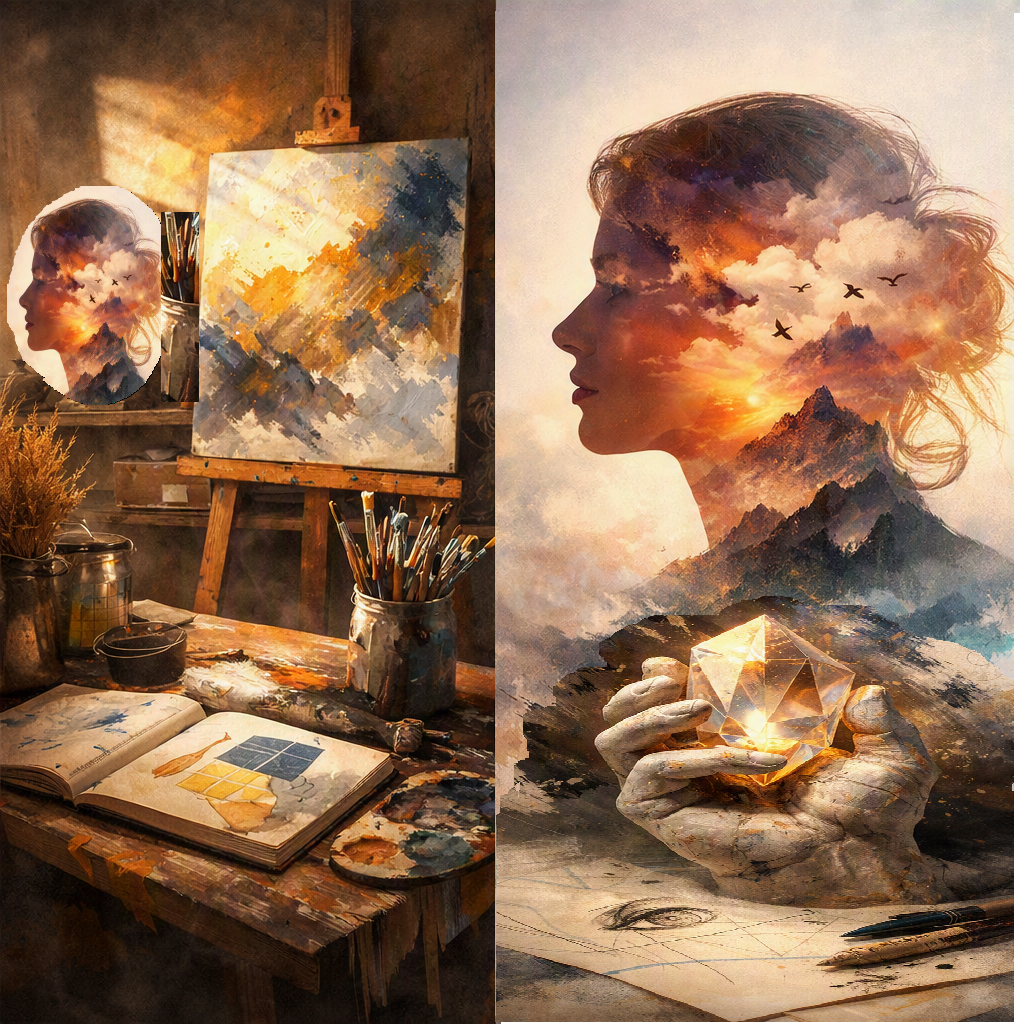
Building an artistic identity: It’s built from within, becoming a distinctive visual signature.
It’s a journey of experience, evolving through mistakes and corrections, gaining expertise and maturity through practice, and taking shape over time..
It is a reflection of the artist’s spirit, their vision of the world, and the emotions they choose to share with others.
What matters is not what is said, but what appears in the artwork without the interference of another self.
Therefore, artistic identity is not what we say… but what appears in our work without our intervention.
? Where does an artistic identity begin
Artistic identity begins from within, through the artist’s values, environment, and ideas about the world around him.
Artistic identity is built from the self and personality, and the unique values ??and ideas that create the spirit of art, including the intrinsic motivation and passion that embodies the spirit of art.
This encompasses the artist’s taste, experiences, cultural background, style, thought, and even quiet moments of inspiration.
Experience
Experience is the raw material of identity. No artistic identity can exist without the accumulation of life experiences and practice.
Through experience, he gains a deeper understanding of color symbolism, the ability to distinguish, and the courage to make different design decisions.
As a result, artistic identity is built gradually, through accumulation, not through sudden leaps.
Personal Style
This is clearly evident in the choice of colors, spatial design, and preferred fonts. The artistic visual rhythm is reflected, embodying the overall atmosphere.
Style is embodied in:
Color selection
Space design
Type of lines
Creative visual rhythm
Expression with complete transparency and profound depth
Influences
nfluences are what is drawn from the world and how it is reinterpreted. On the other hand, artistic identity is not built on imitation, but on reinterpretation.
Moreover, every artist is influenced by something: nature, music, books, personal experiences, cities, light, silence, and even technology. But artistic identity is not built on imitation, but on reinterpreting these influences in your own unique style.
Technology as Part of Identity
In the age of digital design, tools have become an integral part of artistic identity. Discovering the choice of software, working methods, and execution reveals a way of thinking, not just about designs. Technology is not just a tool; It’s part of a unique signature.
Continuity: How do you maintain your identity
Artistic identity isn’t static, but it’s not arbitrary either. It’s cohesive, integrated with several characteristics that crystallize through artistic expression.
In short: Artistic identity is an enduring signature. It’s not something you choose, but something you discover deep within yourself, over time.
It’s the signature that accompanies every work, the imprint that no one can imitate, and the spirit that gives design its unique charm