Expressive design
The Art of Expression Through Design Design is not merely form; it is an art imbued with powerful meaning. True design is not only seen — it resonates, touching the heart directly.
It is more than a collection of arranged elements; it is a conceptual framework. Every color, every movement, symbolizes a stage, shaping impressions and ideas. Gradations of size or hue suggest distance, proximity, or rotation. The language of design is told through color, line, rhythm, and space.
The visual narrative is what breathes life into design. It invites the
Pause, reflect, and appreciate the importance of every detail.
Design without art loses its soul
Because people don’t react to information as much as they react to it, which evokes in them a desire for deeper understanding and broader exploration, rather than simply arousing their emotions.
Emotional stimulation.
Unleashing potential.
Facilitating understanding.
Creating emotional connection.
Deep design reflects a profound understanding of the surroundings and an awareness of what lies within, requiring a harmony between what is seen and what is felt, resulting in spontaneous harmony.
The designer uses architectural repetition, symmetry, and contrast to create a sense of spaciousness and structural richness within a limited space. This creates a visual rhythm, balance, and unity within the building or space, which is one of the most important principles of basic architectural design. It gives facades and floor plans a system that helps the viewer fully grasp the structure.
As a result, it’s as if they are in an endless world of twists and turns, even though it’s a single location.
Furthermore, they utilize this space to attract attention and enhance the feeling of immersion in the design, as if the viewer has unconsciously entered it.
Because humans don’t just react to information, but to what affects them, stirring their emotions and imprinting images in their minds.
This enables them to analyze the dimensions of a design and understand what isn’t explicitly stated, allowing them to grasp the concept directly.
For example, when describing a hall, building, or city, a well-designed image can transport the viewer to an entire world, whereas in reality, the facade of a massive building or city might conceal its interior structure or components. Once the design is visualized,
all obstacles to conveying the idea at first glance, or through touch if the design is for a product with varying dimensions, disappear.
A visual representation might only show the facade or sides, depending on the viewing angle, but a clever design illustrates all aspects with geometric lines in the form of straight points or through color gradients.
Sometimes, a designer uses a scale model to illustrate a massive structure, meaning that design has the power to make the entire earth visible to the naked eye, with its mountains, valleys, and surrounding landscape.
Some countries are also developing smart maps that display miniature natural spaces, allowing users to see gardens nestled among buildings, complexes, and skyscrapers.
Not everyone with design knowledge is a designer.
A designer must possess creative ideas that give their design a unique character for a specific purpose, distinguishing it from others.
For example, a template designer creates a template for a specific purpose, such as the templates used on premium websites, which bear the designer’s name.
Similarly, summer and winter clothing styles are named after their designers.
For instance, the designer of the most accurate model of the Varnas bird in history is named after him, as is the Ford car.
Therefore, design, and then its implementation and production—that is, the designer’s ideas—is a form of evolving and growing creativity, not a fleeting phenomenon.
Elements of Visual Narrative
a) The Core Message
: Every story begins with a question
? What do I want to say
A design should convey one clear message; however simple it may be
b) Visual Character
This is the “soul†of the design—the style, tone, mood, and identity that distinguishes it from others
c) Visual Flow
How does the eye move from one element to another
Flow is what makes the story move
d) Symbols and Allusions
A small symbol can carry a big meaning
Symbols add layers of depth without the need for words
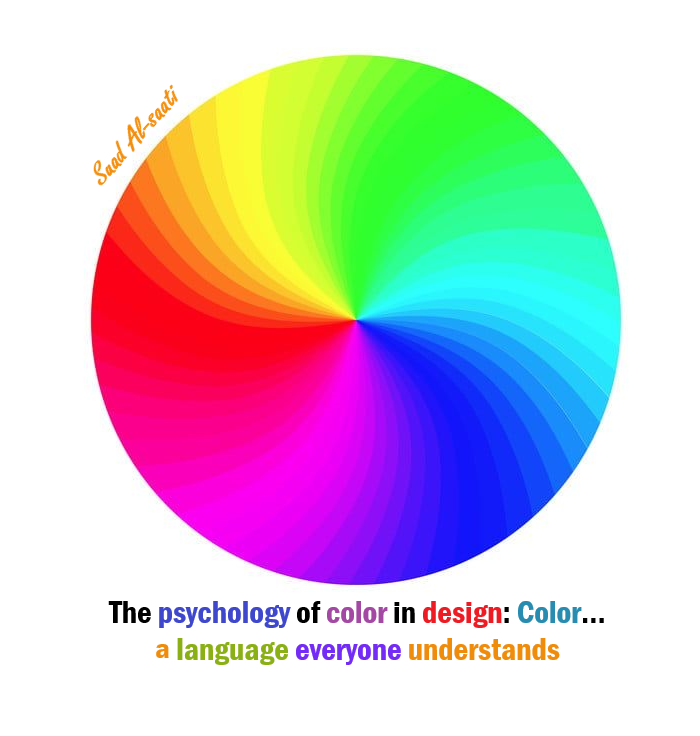
Color as a Silent Narrator
Colors are not just a background
They are emotions
Blue tells a story of confidence and tranquility
Red tells a story of strength and passion
Yellow tells a story of light and inspiration
Black tells a story of luxury and mystery
Color is the first sentence in the visual story
A line is not just a shape
It is a voice
Lines as the Voice of the Story
A soft line tells a story of tranquility
A bold line tells a story of strength
A curved line tells a story of kindness
A geometric line tells a story of order
Choosing a line is choosing the “tone†of the story
Emptiness… The space where things are said without words
Emptiness is not empty silence, but a space for meaning
It allows the story to breathe and gives the viewer a chance to reflect
Emptiness is the line that isn’t written… but is understood
? How to write a successful visual story
Start with the message –
? What do you want the viewer to feel
Choose only the elements that serve the story –
Every element should have a role
Use rhythm to guide the eye –
Make the story move
Give the design room to breathe –
Emptiness is part of the. narrative
Make the ending clear
What do you want the viewer to remember after seeing it
Make the ending clear
Conclusion: Design as a story to be seen
Design that tells a story is unforgettable
It lives on in the memory, leaves a mark, and creates a connection between the work and the viewer
It is a design that transcends beauty… to reach meaning
Emptiness And in the end… Every design is a story waiting to be told, and every designer is a storyteller searching for the most honest way to express what they feel.
Related articles
Design as therapy and innovation
And Art Psychology
Definition of the general concept of inspiration
The language of light and pulse: Inner
Mind is Logical Philosophy
nspiration-through-silence
Design tells stories
Color Psychology in Design
Hardships breed innovation
Social media, and internal distance
Divine Inspiration Emanating from the Soul
Benefits of Social Media
Ideas resulting from the interaction
Spaces of Inspiration